Rohingya Refugees Use Art to Document Atrocities and Seek Justice
 ··2 min read
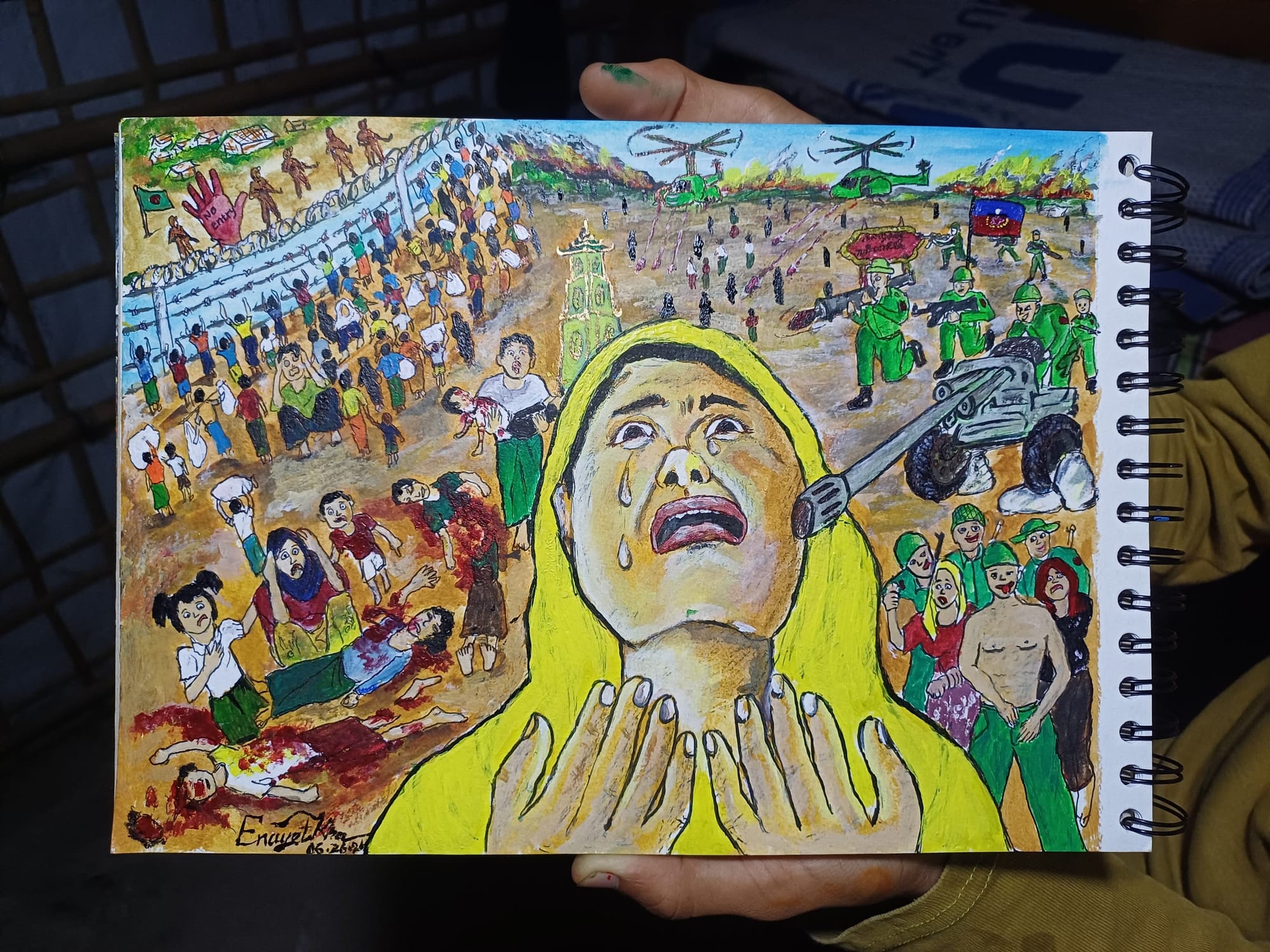
Rohingya refugees in Bangladesh are using art to document and process their experiences of violence and persecution in Myanmar. Enayet Khan, who fled Myanmar in 2017, established the Rohingya Art Club (RAC) to encourage visual storytelling as a form of expression and resistance.
Khan and his family fled their burning home, moving through forests and fields to escape armed soldiers. They crossed the border into Bangladesh, where nearly one million Rohingya refugees now reside. The Rohingya have faced decades of discrimination and repression in Myanmar, including being stripped of citizenship by a 1982 law, leaving them stateless.
Khan's art and that of other refugees serve multiple purposes. It helps them process the atrocities they have witnessed, including burning homes, fleeing families, and executions. Additionally, such artwork can play a role in accountability efforts, helping to convey testimony, corroborate survivor accounts, and even enter legal proceedings as evidence of mass atrocities.
The use of art as a tool for documentation and justice is not unique to the Rohingya. Around the world, more displaced people are turning to international courts to seek justice for crimes against humanity, genocide, and war crimes. In the European Union, investigations and prosecutions of such crimes have surged, with new cases increasing by 44% between 2016 and 2021.
This trend highlights the growing recognition of the importance of documenting and preserving the experiences of refugees and displaced persons. As the global number of forcibly displaced people reaches a record 117.8 million, the need for such documentation becomes increasingly urgent.
**Context:** The Rohingya crisis is a complex and ongoing humanitarian issue, with roots in decades of systemic discrimination and violence. The use of art by Rohingya refugees to document their experiences not only serves as a form of personal healing but also contributes to the broader effort to seek justice and accountability for the atrocities committed against them. This is part of a global trend where displaced people are increasingly using art and legal mechanisms to document their experiences and seek redress for the crimes committed against them.